From the ISS Science Newsletter:
On June 17 and July
26, NASA tested the Surface Telerobotics exploration concept, in which
an astronaut in an orbiting spacecraft remotely operates a robot on a
planetary surface. In the future, astronauts orbiting other planetary
bodies, such as Mars, asteroids or the moon, could use this approach to
perform work on the surface using robotic avatars.
·During the June 17
test, Expedition 36 Flight Engineer Chris Cassidy of NASA remotely
operated the K10 planetary rover in the Roverscape – an outdoor robotic
test area the size of two football fields located at NASA Ames –
hundreds of miles below on Earth's surface from his post aboard the International Space Station
(ISS). For more than three hours, Cassidy used the robot to perform a
survey of the Roverscape’s rocky, lunar-like terrain. The July 26 test
picked up where Cassidy left off. Fellow Expedition 36 Flight Engineer
Luca Parmitano of the European Space Agency remotely-controlled the
rover and began deploying a simulated Kapton film-based radio antenna.
·The
primary goal of the Human Exploration Telerobotics project is to
understand how human and robot activities, such as Surface Telerobotics,
can be coordinated to improve crew safety, enhance science activities
and increase mission success while also reducing cost, risk and
consumables, such as fuel and oxygen, during future exploration
missions.
K10 Black planetary rover at NASA Ames Research Center
No one drowned in space, and the crew is fine but for a little while it was bit dicly. Luca Parmitano, the first Italian to preform a spacewalk was on his second spacewalk of his career. He report that there was some water on the back of his head. The amount of water started to increase, and it moved to the front of his helmet and got into his mouth, nose, and eyes. Luca was outside the ISS in his spacesuit with his EVA (extravehicular activity) crew-mate Chris Cassidy. Both these guys are cool customers, Luca is a Major and former test pilot in the Italian Air Force who enjoys skydiving and SCUBA diving. One thing to point out about Luca that in 2007, he was awarded the Medaglia al Valore Aeronautico d'Argento (Decoration for Aeronautical Valor in Silver) by the President of the Italian Republic, after safely landing his AMX in emergency due to a bird strike. This was not Luca's first or last brush with death. There is a reason he was selected as an astronaut. His partner outside the space station was Commander (US Navy, not of the ISS) Chris Cassidy, the second Navy SEAL in space. Chris is a combat veteran with 10 years of experience in the SEALS and two Bronze Stars for Valor during operations in Afghanistan. While the FCT (Flight Control Team in Mission Control at Johnson Space Center in Houston, TX) talked with Luca with some troubling shooting steps to try to figure out where the water was coming from Chris chimed in, that it could be urine, right after Luca said he drank some. This helped ease some of the tension in the FCR (Flight Control Room), even in space jokes about peeing are still funny.
NASA astronaut Chris Cassidy, Expedition 36 flight engineer takes a picture while outside the ISS for EVA 23 Photo Credit: NASA
"ISS mission management team leader Kenneth Todd, joined by flight
director David Korth and EVA officer Karina Eversley, confirmed the
seriousness of the problem at an afternoon press conference. Korth noted
that EVAs are already dangerous. For Parmitano, this experience was
like plunging one's head into a sloshing fishbowl, with no way to get it
off.
Eversley agreed that the choking hazard from inhaled water was real, and
it eventually caused flight controllers to terminate the spacewalk.
Todd said he was proud of the way the ISS team handled the
near-emergency, one they had never encountered before. "The crew was
cool and expert in reporting and diagnosing the problem. Our training on
the ground paid off, and the team kept its eye on the main
objective"—the crew's safety." From ISS Astronauts Have a Spacewalking Close Call - Popular Mechanics
For an idea of why this was dangerous look at this video Chris Hadfield, the first Canadian Commander of the ISS, made while he was up there.
Now image all that water on your face, it affects you seeing where to go, being able to talk on the radio, breathe, now it gets scary.
There are two sources of water in a spacesuit other then urine (the diaper the astronauts wear should prevent this): the EMU (Extravehicular Mobility Unit, aka the spacesuit) cooling system that holds about 3.8 liters of water and the water drink bag which holds about 1 liter.
In the earlier EVA# 22 when taking off Luca's suit it was reported there
was a lot of water in this helmet, special steps were given to dry out
the suit. This water was believed to come from his drink bag. The drink bag was found to be empty. He was
given a new drink bag to use on EVA #23.
I would rule out the drink bag as the issue beacuse:
A. He was given a new one
B. It only hold about 1 liter of water, the crew reported 1 -1.5 liter of water in his helmet.
C. He would have been drinking some water in the first hour of the spacewalk reducing the amount in his drink bag
The cooling system for the EMU seems to be the cause of the issue in my mind. It holds 3.8 liters of water. That's more than enough to have caused the flood in Parmitano's helmet, estimated at about 1 to 1.5 liters. The cooling water moves from the heat exchanger to inside the suit onlong the astronauts skin via the Liquid Cooling Garment (LCG). To cause this leak there has to be something wrong with the LCG or the connection that supplies the LCG.
For those of you who were not spacesuit field test engineers here is something to help you understand how spacesuits work:
How NASA Spacesuits Work: EMUs Explained (Infographic)
by Karl Tate, Infographics Artist, Space.com
You can read the rest of the article HERE.
To see the NASA press release go to This Website
Also now from NASATV see the coverage of the leak discussion:
Now the big question you are wondering where was I during all this excitement? I was in MCC, not in FCR but one of the support rooms. I was training on learning how to work the Bio-hardness, which the astronauts wear that get all their Bio data and send it to the ground for the Flight Surgeons. The job which I was training for was to make sure all the bio data made it down to the ground, and trouble shoot any problems that arise.
For current process on finding the water leak issue the very smart engineers and EVA operations personnel are still work on it. I will let you know once they find out something.
A few weeks ago I posted Science Time on the ISS Part 1, where I talked about how research on the International Space Station (ISS) is helping in the fight against cancer. A few days after that post, NASA released an article Fighting Cancer with Microgravity Research which outlines what NASA is doing on the ISS to help with cancer research.
Why is cancer research in space different from research on the ground?
The human body is made up of cells, which normally grow within support structures made up of proteins and carbohydrates which allows the cells that form organs in the human body to maintain their three-dimensional (3-D) shapes. In labs on Earth, scientists can only grow cells on flat surfaces, they cannot create the 3-D shapes that form human organs. The cells do not behave the way they would if they were in the same 3-D shapes if they were in the human body. This makes it very hard to study cancer.
Well in space, there is no gravity, so support structures of proteins and carbohydrates are not needed. Vitro cells, cells not inside a living organism, arrange themselves into 3-D groupings called aggregates. These closely resemble what happens in the human body and allow scientists to study a more accurate model.
Dr. Jean Becker, PhD, a cell biologist at Nano3D Bioscienes in Houston and the principal investigator CBOSS-1-Ovarianstudy (the study on the ISS), "So many things change in 3-D, it's mind-blowing -- when you look at the function of the cell, how they present their proteins, how they activate genes, how they interact with other cells. The variable that you are most looking at here is gravity, and you can't really take away gravity on Earth. You have to go where gravity is reduced."
There have been early studies with 3-D cell formation in space on Space Shuttle missions STS-90 and STS-107. More information can be found at the linked article above.
So when people ask what the ISS is doing for them, please remind them, its one of our best bets to understand cancer.
When floodwaters swept through downtown Calgary in Alberta, Canada on June 22 it forced over 100,000 people to evacuate the rising waters. The International Space Station (ISS) stepped in to help, using the newly installed camera called the ISS SERVIR Environmental Research and Visualization System (ISERV), the ISERV ground control team took a number of pictures, 24 to be exact, when the ISS passed over Calgary to help with the emergency response and assessment of damage.
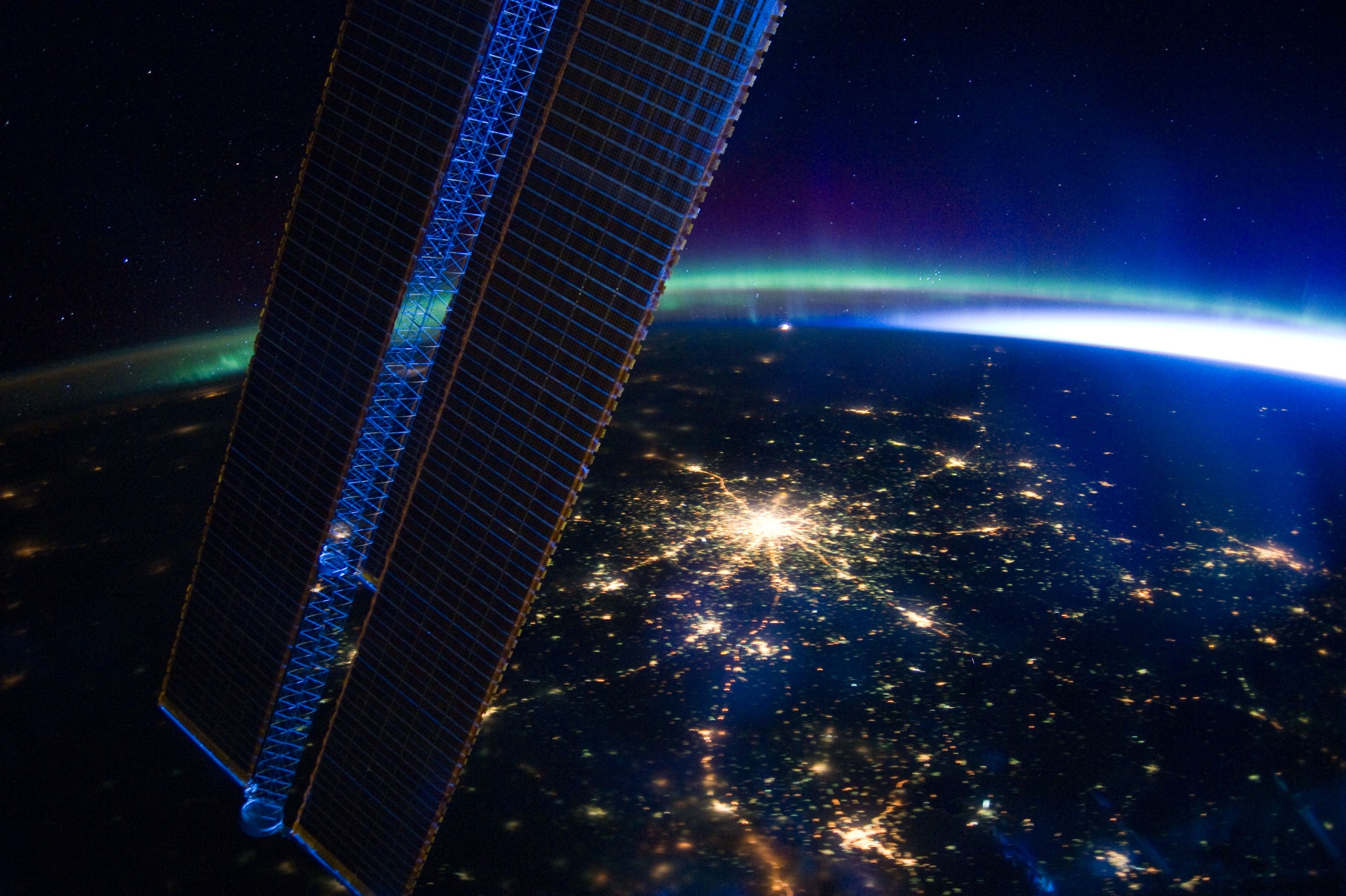
Earth as seen from the ISS
In January ISERV was installed in the Earth-facing window of the ISS's Destiny module (or the LAB as it is know in Mission Control). From that small window on the ISS the camera is able to photograh 95% of the planet's populated area during the ISS's orbit. This allows researchers on the ground to use the high-resolution camera to take pictures of pretty much any where on the globe. These images are helping decision makers address environmental issues, humanitarian crises and disasters -- such as the recent floods in Canada. ISERV was developed by NASA to support a joint project between NASA and the U.S. Agency for International Development (USAID) known as SERVIR, Spanish for "to serve." The SERVIR project provides satellite data and tools to environmental decision-makers in developing countries and operates via regional hubs in Nairobi, Kenya; Kathmandu, Nepal; and Panama City. Through these hubs, SERVIR provides decision-support data, tools and applications for drought and flood monitoring, landslide probability mapping, disease incidence mapping, air quality and environmental condition monitoring and more.
One last thing to point out about the ISERV, it was installed by the first Canadian Commander of the ISS, Chris Hadfield.
Here is "Swimming with spacemen: training for spacewalks at NASA’s giant pool". It is a great article about Luca Parmitano of the European Space Agency and Chris Cassidy of NASA's astronaut corps training for their two EVAs (spacewalks) that happened 1 last week, and another tomorrow. It is worth reading HERE
On July 9th and 16th Flight Engineers Chris Cassidy of NASA and Luca Parmitano of the European Space Agency will go outside the ISS to perform two spacewalks. Each spacewalk is scheduled to last 6.5 hours. Cassidy and Parmitano will replace a space-to-ground communications receiver and wireless video equipment and install power and cables for a Russian multipurpose laboratory module that will be launched later this year. The new module will serve as a research facility, docking port and airlock for future Russian spacewalks and will replace the Pirs module.
Cassidy's call sign will be EV1 and Parmitano's call sign will be EV2. Cassidy's spacesuit will have red stripes on it. These two spacewalks will be Cassidy's 5th and 6th EVAs, but it will be Parmitano's first and second as well as him being the first Italian to perform a spacewalk.
To answer the age old question of what do you do in space once you get up there? SCIENCE!!!
I will try my best to keep you up to date with what science is going on at the ISS. I am not personally involved with the science going, I am a little busy keeping the crew alive, but I hear all the call-downs to Huntsville (Where Marshal Space Flight Center is located, the payloads operations center for NASA) about science.
Here is a cool study going on the ISS. It involves saliva from the University of North Dakota's own NASA astronaut Dr. Karen Nyberg and European Space Agency astronaut Luca Parmitano. It is called the Microbiome investigation. Microbiome investigates the impact of space travel on
the human immune system and on an individual's microbiome (the
collection of microbes that live in and on the human body) to help
predict how long-term space travel may impact human health. It is known
that factors such as stress, diet and an impaired immune system can
trigger changes in the human microbiota, increasing the risk of
contracting a disease. The product of this study will be an assessment
of the likelihood and consequences of alterations in the microbiome due
to extreme environments, and the related human health risk. Findings
could be used to benefit people on Earth that live and work in extreme
environments. Other potential applications of this study could be to
further research in preliminary detection of diseases, alterations in
metabolic function and immune system deficiency.
This is really interesting because of something else I have seen. At CHOP, Children's Hospital of Philadelphia there are some researchers using modified HIV vaires to change the human immune system to attack cancer cells. One of the issues thet talk about is that they do not understand how the humman immune system will respond to that level of stress. And here on the ISS now, they are studying the effects of extreme stress on the human immune system. Here is the video #firewithfire
So when someone asks you what science NASA does on the ISS to help people on Earth, just remind them that one of the keys to finding a cure for cancer might come from current studies going on 250 some miles above the Earth.
Canadian Space Agency employees welcomed astronaut Colonel Chris Hadfield as he walked in the building. Credit: Canadian Space Agency.
Canadian Astronaut Colonel Chris Hadfield, the first Canadian to perfrom an extra-vehicular activity (EVA) or spacewalk, first Canadian to control the Canadian arm on the ISS, first Canadian Commander of the ISS announced this retirement from being an active duty astronaut will start on July 3rd, 2013 in Longueuil, Que., Monday, June 10, 2013.
The news media is calling this a surprise but the space community knew this was coming. Colonel Hadfield has had a great 21-year career as an astronaut, two shuttle missions (STS-74, STS-100), a number of EVAs, a full stay at the ISS (Expedition 34/35) and being Commander of the ISS for Expedition 35. There was just not another chance he would get another flight at the age of 53.
There are also two younger Canadian astronaut candidates Jeremy Hansen and David Saint-Jacques waiting in the wings for their first trip into space. The CSA (Canadian Space Agency) does not have any spots for their astronauts to head up to the ISS anytime soon. There are no seats for CSA astronauts in the assigned Expeditions 36-45.
To end this post I have to quote Canadian Parliamentary Secretary Chris Alexander, "I would like to personally
thank Chris for his commitment to bringing the spirit of discovery not
only to all Canadians, but to the world."
For those who know Colonel Hadfield, I have only talked to him about 3 times (but all 3 while he was in space), or follow his youtube, twitter, or facebook this seems approate way to sign off:
Yesterday during handover, when flight control teams switch, there was a new call sign on AFD (Alternate Flight Control Loop). AFD is where flight controllers brief each other on the current state of their respective systems before the start of the shift. This call sign was ATV-FLIGHT, the flight director of ATV-004 (Automated Transfer Vehicle) Albert Einstein.
ATV-004 Albert Einstein was launched at 21:53:11 GMT on June 5th 2013. I was on console this day but it was during the swing shift, and I was on the night shift. By the time I came into work at 04:00:00 GMT June 6th 2013 it was already on its way to the ISS. ATV-004 Albert Einstein is on a course over the next 10 days to reach the ISS and dock on June 15th 2013. A video of the launch can be seen here: ATV-004 Albert Einstein Launch Video
The ATVs are launched from the Guiana Space Centre also known as the Centre spatial guyanais (CSG) which is a French launch complex in French New Guiana. ESA (European Space Agency) is the main costumer of the launch center.
The ESA Ariane 5 rocket is used to launch the ATVs into space.
ATV-004 Albert Einstein has set a number of records for ATVs and the Ariane 5:
Most dry cargo launched in any European spacecraft - 2,480 kilograms (5,500 lb)
Most diverse cargo mix - 1400 different items
Largest quantity of late cargo (cargo added only 2 weeks before launch whileAlbert Einsteinis already mated to the top of the Ariane 5 rocket) - 620 kilograms (1,400 lb)
A full cargo breakdown is provided in the following table
One of the fun parts of being a biomedical flight controller (BME) is that BMEs get to work with the rest of the medical community at Johnson Space Center (JSC). On days like this when optical health testing takes place the BME MPSR or Multi-Purpose Support Room is full of Flight Surgeons, remote guiders, and hardware specialists. This makes the BME MPSR a pretty happening place to be at 2:00 AM.
The station runs on GMT or Greenwich Mean Time which is about 5 hours ahead of Houston time, so the first shift of the day called Orbit 1 (11 PM- 8 AM Houston Time) covers the station's morning, the second shift Orbit 2 ( 7 AM - 4 PM Houston Time) covers the afternoon into the evening, and the third shift Orbit 3 (3 PM - 12 AM Houston Time) covers the nighttime on the station. This means when the optical health testing that takes place in the crew's morning is in the middle of the night in Houston.
The optical testing is pretty cool, it is similar to seeing an eye doctor expect for the crew on the station, expect the eye doc is 250 some miles away and drinking coffee to wake up. There are a lot of great medical gains to these tests but I am going to let someone much more famous then me, and who has had first hand experience tell you all about the optical health testing that is performed on the International Space Station explain it to you: Astronaut Chris Hadfield on how eyesight is affected in space
At the University of North Dakota the Graduate School Office in Twamley Hall where I had to deliver numerous pages of paper work to allow me to graduate. In the hallway of the 4th floor where the Graduate School Office is, are pictures of notable alumni of UND. Right across from the door was a picture of Dr. Karen Nyberg, the first and only astronaut to graduate from UND. Dr. Nyberg is a member of Expedition 36 and currently on-board the ISS. I had the pleasure of meeting Dr. Nyberg when she was training for her mission. And of course I wore my UND swimming polo and had a nice conversion with her about UND.
About a month and a half before I was attending Expedition 35's 100 day party. A celebration of an astronaut's breaking of 100 days in space. This was for Commander Chris Hadifield and Dr. Tom Marshburn. I was happening to be wearing my UND swimming polo (its on my nominal rotation of polos I wear to work) and Commander Hadifield being a Canadian who had been to Grand Forks, ND struck up a conversation about Grand Forks and UND. He also told me that he was unpacking Expedition 36's exercise equipment, including Dr. Nyberg's cycling shoes. He told me he hid a surprise for her in her shoe. I have no idea what it was, but it might end up being a debrief question.
To bring this story full circle I was on console to support Dr. Nyberg's first workday after she arrived on the ISS. And of course I was wearing my UND swimming polo that day.
Roughly one year ago I was walking by her picture in the Graduate School Office, now I am watching her on Downlinked Video from ISS at Mission Control.